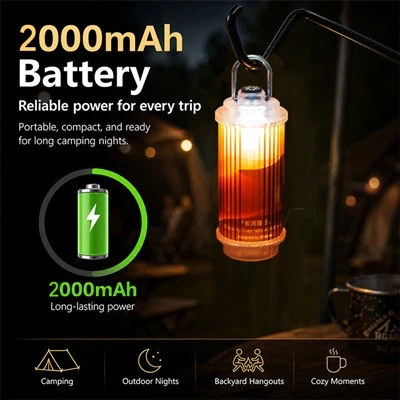
The technical parameters of camping lights mainly include the following aspects:
Lighting duration: The battery life of camping lights is very important, usually more than 6 hours at the extremely bright level. Rechargeable camping lights are energy-saving and environmentally friendly but require charging time, while battery-powered camping lights require carrying multiple batteries.
Lighting brightness: Lumen is a measure of light brightness. The higher the lumen, the brighter the light. Depending on the usage scenario, choose camping lights of different brightness: 100 lumens is suitable for tents for 2-3 people, 200 lumens is suitable for camp lighting and cooking, and 300 lumens and above are suitable for camp parties.
Waterproof: Waterproof performance is divided into nine levels from IPX-0 to IPX-8. The waterproof level of IPX4 is sufficient to meet daily camping needs, while the waterproof level of IPX8 can be waterproof for 30 minutes without leaking, which is suitable for more severe environments.
Fall resistance: Most camping lights are made of tough and flexible PC plastic, which is not only fall-resistant, but also makes the light more uniform and soft.
High color rendering: Camping lights with a color rendering index of CRI ≥ 90 can effectively restore the original color of objects, reduce eye fatigue, and are suitable for outdoor photography.
Ease of use: Good camping lights provide a variety of placement methods. They can be mounted on a tripod to illuminate the camp, or fixed on a tree branch to provide lighting.
Functionality: In addition to lighting, camping lights can also be used as mobile power supplies, red light to protect eyesight, reduce mosquito harassment, and even as distress signals.