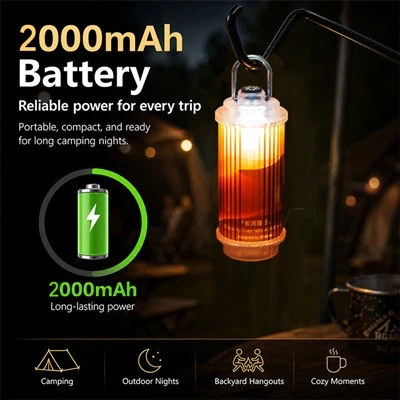
The camping boom and the importance of battery selection:
As the camping craze continues to heat up, camping lantern have become an indispensable equipment for camping enthusiasts. The type of battery that supports the operation of camp lantern has a profound impact on the camping experience. Among them, nickel-metal hydride batteries and lithium batteries have attracted much attention, and they each have their own advantages in the application of camping lights.
Introduction to the advantages and disadvantages of nickel-metal hydride batteries:
NiMH batteries have excellent recycling performance and can be recharged hundreds of times, which gives them certain advantages in long-term use. Moreover, compared with traditional alkaline batteries, NiMH batteries are more environmentally friendly and reduce environmental pollution.
However, NiMH batteries also have obvious shortcomings. They have a self-discharge phenomenon, and the power will slowly drain away even if the camping lamp is idle. This means that the camp lamps you fully charged in advance is likely to be low on power after being left for a period of time, which will affect the lighting effect when camping.
Advantages and safety of lithium batteries:
On the other hand, lithium batteries, in addition to the long battery life advantages brought by high energy density and extremely low self-discharge rate, are also more remarkable for their safety.
Lithium batteries are designed with multiple safety protection mechanisms, such as overcharge protection, over-discharge protection, and short-circuit protection. When the battery reaches a certain voltage upper limit, the overcharge protection circuit will automatically cut off the charging circuit to avoid dangers such as battery bulging or even fire and explosion caused by overcharging; during the discharge process, once the voltage drops to the safe lower limit, the over-discharge protection will be activated to prevent the battery from being damaged by excessive discharge. In addition, the short-circuit protection function can respond quickly when the battery is accidentally short-circuited, effectively preventing the safety hazards caused by abnormal current.
From the perspective of battery materials themselves, the materials used in lithium batteries are constantly improving in stability, reducing the risk of chemical reactions going out of control during battery use and storage. After a large number of experimental tests and actual application verification, the safety of lithium batteries under normal use conditions has been reliably guaranteed. At the same time, with the rapid development of technology, the safety and stability of lithium batteries are still improving, further reducing the risks during use.
Cost comparison analysis:
From a cost perspective, although the initial purchase cost of lithium batteries is relatively high, given their significant characteristics of long battery life and low self-discharge rate, from the perspective of long-term use, the overall cost is actually comparable to that of nickel-metal hydride batteries. On the other hand, although nickel-metal hydride batteries require less initial investment, their frequent charging needs and power loss caused by self-discharge will lead to a gradual increase in subsequent use costs.
Expert advice and user selection guide:
From a professional perspective, lithium batteries are the best choice for camping enthusiasts who pursue extreme battery life and convenience, especially those with high safety standards; while nickel-metal hydride batteries are an economical and practical solution for users who focus on cost and have relatively low battery life requirements.
For camping enthusiasts, the following aspects can be considered when choosing a suitable campsite lamp battery. If the camping trip is short, the battery life requirements are not high, and the budget is limited, and camping activities are only carried out occasionally, then nickel-metal hydride batteries are a more suitable option, and their low initial cost can meet basic needs.
However, if you camp frequently and for a long time, such as conducting multi-day outdoor adventures, you have high requirements for battery life and safety, then lithium batteries are a more ideal choice, which can not only provide long-term stable lighting, but also ensure safe use in various complex environments.
In addition, if you are used to preparing camping equipment in advance and expect the battery to be fully charged after being stored for a period of time, the extremely low self-discharge rate of lithium batteries can also meet this demand.
The trade-off between battery life and safety:
When choosing batteries for camping light lantern, both battery life and safety are crucial. It is difficult to simply judge which is more important. They play a key role in different camping scenarios.
For short-term camping activities, the battery life requirement is relatively low, and safety becomes a factor that needs to be considered more. In the wild environment, once the battery has safety problems, such as overheating and fire, it will not only damage the camping lantern lights, but also threaten the personal safety of the campers, destroying the entire camping experience.
In long-term camping trips, the importance of battery life is highlighted. If the battery life of the camping light is insufficient and you are away from the power supply point for a long time, you may fall into a lighting dilemma in the dark, affecting the safety of your actions and the arrangement of activities. For example, in a multi-day camping in the mountains, you need sufficient lighting every night to carry out activities. At this time, the battery with long battery life can ensure that the camping lantern lamp continues to work stably and provide enough light.
In fact, the ideal situation is to find a balance between the two. Lithium batteries take into account both battery life and safety to a large extent. With the development of technology, its advantages in these two aspects have become more and more obvious, which is why it is increasingly favored by camping enthusiasts.
Industry Outlook:
As the camping market continues to expand, the research and development of battery technology is also accelerating. Looking to the future, both nickel-metal hydride batteries and lithium batteries have the potential to achieve major breakthroughs in performance, which will provide camping enthusiasts with a better lighting experience.